This article is part of the Fixed Assets module training. Learn more about the Fixed Assets module and the Asset record, where these actions can be performed.
The Asset Actions menu appears after an Asset draft has been saved for the first time. Action options vary depending on the status of the Asset and include the following actions:

Duplicate
Available on all statuses. The Duplicate action creates a modified copy of the Asset in a new tab, which has a generated number value aggregated as if the user had selected to create a new Asset. The user can then make any necessary changes and save the new Asset under an updated name.
Split
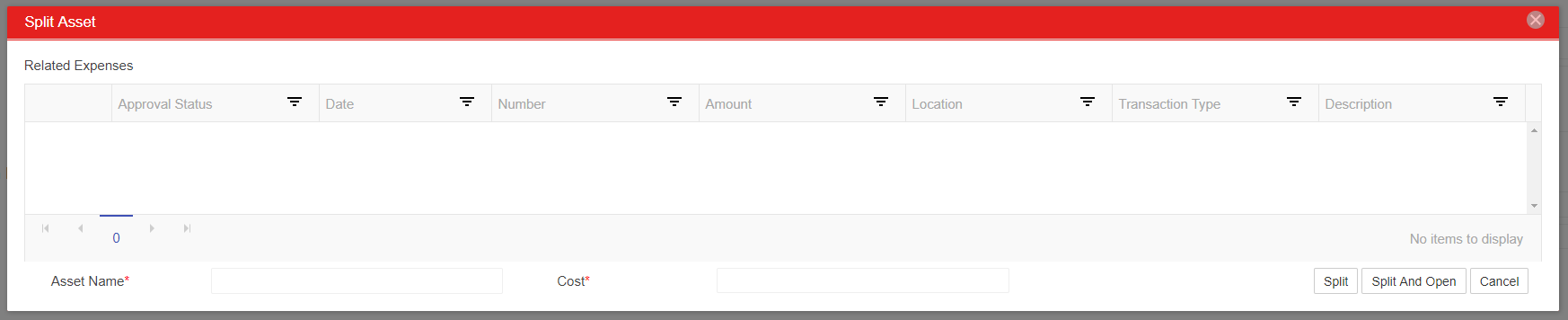
Available on Draft and CIP Assets. The Split action splits a single Asset into two separate Assets. Upon selecting Split, the Split prompt opens, where the user can review expenses related to the Asset, then enter the second Asset's name and cost.
Clicking Split will save the Split, update the Current Cost of the first Asset, and close the prompt.
Clicking Split And Open will save the Split, update the Current Cost of the first Asset, and open the second Asset record, where the Cost amount will be the Current Cost.
Cancel closes the Split prompt without performing any actions.

Begin Construction
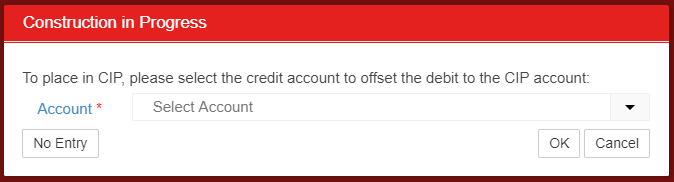
Available on Draft Assets. The Begin Construction action updates the status of an Asset from Draft to CIP.
When selected, the Construction in Progress prompt will appear, where the user must select the Credit Accounts to offset the Debit to the CIP Account. Refer to CIP & Active Offset Accounts for more information on which account to select.
Once the selection has been made, click OK and the Asset status changes to CIP.

Place in Service
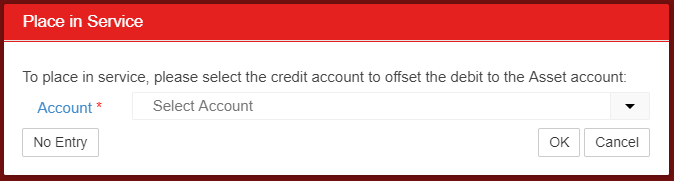
Available on Draft and CIP Assets. The Place in Service action updates the status of an Asset from Draft or CIP to Active.
If moving from Draft directly to Active, the Place in Service prompt will appear, where the user must select the Credit Accounts to offset the Debit to the Asset Account. Refer to CIP & Active Offset Accounts for more information on which account to select.
If moving from CIP to Active, the Credit Account was already selected when the asset moved from Draft to CIP.
Once the selection has been made, click OK and the Asset status changes to Active.

Depreciate
Available on Active Assets. The Depreciate action opens the Depreciation form to post (or preview) depreciation for the Asset. Refer to the Depreciation Form training for more information.

Asset Disposal
Available on Active and Active Fully Dep. Assets. The Asset Disposal action records the disposal (and sale) of an Asset and moves the Asset to Retired status.
When selected, the Asset Disposal prompt will appear, where the user must select the Disposal Date. If the Asset was sold, click the Yes toggle to enter the Amount and Account of the sale. The Amount value is recorded in the Account on the final Depreciation Journal Entry used to retire the Asset.

When each required field has been updated, click Process Disposal to open the Confirmation prompt.



When an Asset is disposed with a sale, the final Depreciation Journal Entry debits Accumulated Depreciation for the Asset's accumulated depreciation, credits the Asset account for its original cost, and records any gain or loss on the sale to the Account selected during disposal. The gain or loss is the difference between the sale Amount and the Asset's net book value (cost minus accumulated depreciation) at the time of disposal: a sale Amount greater than the net book value produces a gain, and a sale Amount less than the net book value produces a loss.
R365 recommends selecting a dedicated Gain/Loss on Disposal of Assets GL account as the disposal Account, and confirming that account is categorized correctly for Cash Flow reporting so the disposal is reflected accurately on the Cash Flow Statement.
Removing the Asset's cost and accumulated depreciation reduces its net book value to zero on the balance sheet as of the Disposal Date.
Partially Retire
Available on Active and Active Fully Dep. Assets. The Partially Retire action records the partial retirement (and sale) of an Asset and moves the Asset to Retired status.
When selected, the Partial Retirement prompt will appear, where the user must select the Partial Retirement Date and enter the amount (of the remaining Current Cost) to partially retire. If the Asset was sold, click the Yes toggle to enter the Amount and Account of the sale. The Amount value is recorded in the account on the Depreciation Journal Entry used to partially retire the Asset.


When each required field has been updated, click Partially Retire to open the Confirmation prompt.


When a Partial Retirement is processed, the Depreciation Journal Entry debits Accumulated Depreciation for the portion of accumulated depreciation attributable to the retired amount, credits the Asset account for the retired portion of the Acquisition Cost, and records any gain or loss to the asset's configured Gain/Loss on Sale account. Accumulated Depreciation and Salvage Value are both reduced proportionally to the reduction in Acquisition Cost, so Life-to-Date Depreciation never exceeds the asset's new, lower Cost Basis, including for assets that are already fully depreciated. The asset's remaining depreciation schedule recalculates based on the reduced Acquisition Cost, Accumulated Depreciation, and Salvage Value.
If a Partial Retirement amount would leave Life-to-Date Depreciation greater than the asset's new Cost Basis, the system does not process the retirement.
Partially retiring an asset also reduces its Salvage Value proportionally to the retired percentage of Acquisition Cost, whether or not the asset is fully depreciated. Undoing a Partial Retirement restores the asset's original Salvage Value exactly.
Location Transfer
Available on Active and Active Fully Dep. Assets. The Location Transfer action transfers the Asset record from one location to another.
When selected, the Asset Location Transfer prompt will appear. For all Location Transfers, the user must select the New Location, then enter the Transfer Date.

If a sale is not associated with the Location Transfer:
Select the appropriate Credit Account to offset the debit to the new location's Asset Account, then click Process Transfer to complete the Location Transfer.
If a sale is associated with the Location Transfer:
Change the Is there a sale associated with the transfer of this asset? toggle to Yes. The Asset Location Transfer prompt will update with new fields.

The next steps depend on whether the existing Asset needs to be retired. If the existing Asset is not being retired, the Location Transfer can be completed in the Location Transfer prompt. However, if the current Asset is being retired, the current Asset needs to be disposed and a new Asset created.
If the current Asset is not being retired:
Enter the Sale Amount.
Select the appropriate Account to associate with the sale. The Sale Amount value will be recorded in this Account on the final Depreciation Journal Entry for the Asset.
Select the appropriate Credit Account to offset the debit to the new Location's Asset Account.
Click Process Transfer to complete the Location Transfer.
If the current Asset is being retired:
The following instructions are for when the retirement of the Asset for the original location and the acquisition of the Asset for the new location need to be recorded.
1) Click Cancel to exit the Location Transfer prompt.
2) Click Action, then Asset Disposal.
The Asset Disposal prompt opens.

3) Enter the Disposal Date, select whether or not there was a sale associated with the Asset disposal, then click Process Disposal.
Learn more about Asset Disposal above.

4) Open the Create menu, then select Asset.
Now that the asset is disposed of for the original location, create a new asset for the receiving location.

5) Enter all of the Asset information on the new Asset record.

The Acquisition Date should be the same as the Disposal Date that was used, and the Acquisition Cost should be the same as the Sale Amount.
6) On the Books tab, confirm that the Depreciation Method, Convention, and Effective Life are correct before saving the asset.

7) Click Save, then select Save to save without closing.
The Action button then appears.

8) Click Action, then select Place in Service to place the new asset into service.
Learn more about the Place in Service action above.

9) Select the bank account that provided the funds for the purchase of this asset.

No Entry should not be selected in this case.
10) Select OK.
The location transfer is now complete and reflected for reporting purposes.
Depreciation Report
Available on Active, Active Fully Dep., and Retired Assets. The Depreciation Report action opens the Depreciation Report for the Asset.
When selected, the Depreciation Posting report will open in a new tab. This is the same report that loads from the Depreciation form. The report breaks out depreciation totals by Asset Class and Assets within the class. When run from the Action menu, only this Asset is included in the report. To view the report with multiple Assets, run it from the Depreciation form.
The report parameters can be updated to view either Unposted depreciation or Posted depreciation.
Undo Retirement
Available on Retired Assets only. The Undo Retirement action reverses the Asset Disposal action. To undo a Partial Retirement, the Asset must first be fully retired, then Undo Retirement can be used for the full amount.
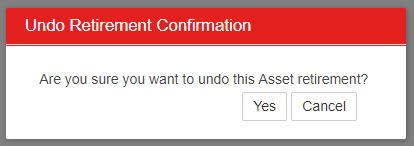
When selected, the Undo Retirement Confirmation prompt will appear, where the user can select Yes or Cancel.
When Yes is clicked, the Asset retirement is undone and the Asset status changes from Retired to Active. Any remaining depreciation postings are regenerated on the Postings tab.

Return to the Asset record training page.